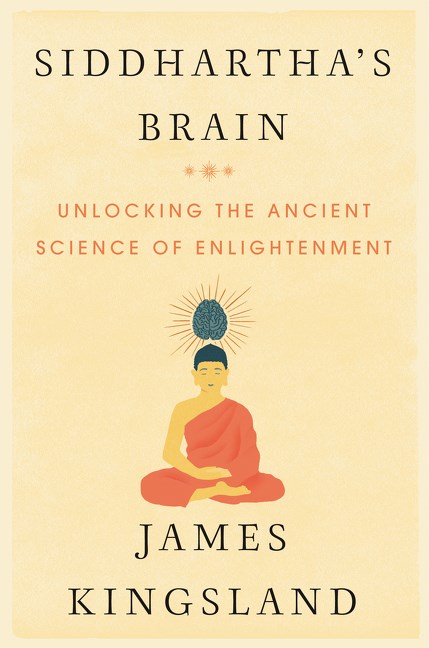
Hot off the press!

SiddharthasBrain

My new book about the mind-blowing new “science of enlightenment” – which is stuffed with neuroscience, psychiatry and psychology, but also some wonderful Buddhist stories and guided mindfulness meditations – will be published on 26 April in the US and 2 June in the UK. I received my personal copy through the post yesterday, so I couldn’t resist sharing a few quick thoughts.

One of my principal inspirations for writing the book was a long conversation I had in 2014 with a charming Buddhist monk called Ajahn Amaro, the abbot of Amaravati Buddhist Monastery in the little village of Great Missenden near Hemel Hempstead in the UK. Before his ordination into the Thai Forest tradition he trained as a scientist at the University of London in the 1970s, earning a degree in physiology and psychology. As we chatted it became clear he sees Buddhism as a kind of internalised cognitive psychology formulated in Ancient India by Siddhartha Gautama (the Buddha) – thousands of years before “science” had been invented. He believes that the role of his monastery is to carry on that tradition.

“We don’t run labs and such,” the abbot told me, “but our way of practicing and teaching meditation is very experientially based – it’s what actually helps people. We are working with the mind to understand it better and train it to be more malleable and function in a more balanced way.” He even went so far as to say we are “all mentally ill”. According to Buddhist philosophy, only perfectly enlightened beings can be considered 100% sane. Such people see the world as it truly is, stripped of the greed, aversion and delusion that clouds the untrained minds of more ordinary folk like you and me.

I followed up my conversation with Ajahn Amaro by interviewing many of the leading scientists investigating the neuroscience and potential benefits of meditation, including the two inspirational people who brought this whole new field into existence in the 1980s, Jon Kabat-Zinn and Herbert Benson. The more I learned about Buddhism and meditation, the more at home I felt with them, both as a sceptical (even cynical) science journalist, and as someone with a cranky human mind. I began to meditate myself and attend retreats.

Famously, Siddhartha told his followers:

“Don’t go by reports, by legends, by traditions, by scripture, by logical conjecture, by inference, by analogies, by agreement through pondering views, by probability, or by the thought, ‘This contemplative is our teacher’. When you know for yourselves that, ‘These qualities are unskillful; these qualities are blameworthy; these qualities are criticised by the wise; these qualities, when adopted and carried out, lead to harm and to suffering,’ then you should abandon them.”

In other words, “Take no one’s word for it” or Nullius in verba in Latin, which is the motto of the Royal Society. Stripped of its cultural baggage (there’s plenty of that, of course, after two and half millennia) Buddhism is the anti-dogma religion. You’re not expected to believe in a creator god or follow a creed, just investigate your own experience, carefully, objectively, with an open mind.

Siddhartha’s Brain brings together this ancient philosophy with the discoveries of rigorous, hi-tech modern science. I hope people will enjoy reading it as much as I enjoyed researching and writing it.

 

Ayahuasca boosts mindfulness

ayahuascaLargeMeditating can be hard, lonely work, but if recent research is to be believed there may be a quick-and-dirty shortcut to enlightenment: psychedelic drugs. According to an exploratory study, drinking the hallucinogenic brew ayahuasca can bring about improvements in mindfulness that would take years of dedicated meditation to achieve. The research found that ayahuasca raised mindfulness abilities to levels equal to or even greater than those of people who have been practising meditation for around seven years.

Continue reading “Ayahuasca boosts mindfulness”

Can meditation slow ageing?

OldAge2Do people who meditate age more slowly? It seems unlikely on the face of it. How could sitting immobile with one’s eyes closed, perhaps focusing on the breath, possibly keep the Grim Reaper at bay? That said, the Buddha – surely the archetypal meditator – is reputed to have lived to 80, which must have been an exceptionally ripe old age in 5th century BCE India. And according to Buddhist scriptures, even after 80 years in this realm of existence, in the end it wasn’t old age that finished him off but food poisoning.

Read the rest of the article at The Guardian where it was originally published on 3 March 2016.

Image: Kris Krüg

Is this the brain’s mindfulness switch?

Thalamus small.gif

Journalists adore research that allows them to write stories along the lines of “scientists have tracked down the brain’s love HQ” or “researchers have located the brain’s god spot”. It is very satisfying to imagine that we can divide the brain into neat components with distinct functions like the parts of a car engine. We dream that one day, neuroscientists will be able to lift the bonnet (or the hood if it’s an American brain), point and say “here’s the valve that causes schizophrenia – we can readjust that with this chemical spanner. Here’s the tank that causes OCD when it overflows – we can drain that by turning this tap here. Over there are the spark plugs that we clean up to cure depression …”

Unfortunately the brain is a lot messier and more wonderful than your average motor engine, which is why we’re still standing over it scratching our heads trying to figure out how on earth it all works. It’s a tangle of connections, with myriad networks of components involved in creating thoughts, consciousness, sensations and emotions.

So it is with a mixture of excitement and wariness that I approach a study by researchers at Beijing Normal University in China that seems to point to a particular part of the brain that switches mindfulness on and off. It’s called the thalamus (shown in red on the animated gif), a pair of bulbous structures that sit at the top of the brainstem (yellow) on the midline of the brain. The thalamus plays a pivotal role as the brain’s switchboard, relaying information from all the senses apart from smell to the cerebral cortex, which is the thinking, conscious part of the brain. Continue reading “Is this the brain’s mindfulness switch?”

Meditation or medication for depression? A reality check

Prozac (fluoxetine) antidepressant pills
Research has suggested meditation is as effective as taking an antidepressant for mild depression

There was good news last week about the effectiveness of mindfulness meditation for easing anxiety, depression and pain. Mail Online reported that a study had found “meditation ‘works just as well as anti-depressants’: half an hour a day offers as much relief as tablets”, while The Boston Globe said those who took mindfulness classes experienced improvement in mood after eight weeks “on par with the effect seen with prescription medications”.

This was all perfectly true. A review published in JAMA Internal Medicine had looked at all the best studies to date and concluded that there was “moderate evidence” of improved anxiety, depression and pain among patients. The effect on mild depression was indeed equal to that achieved with anti-depressants.

Like me, though, you may be a bit underwhelmed by that phrase “moderate evidence”. It’s hardly a ringing endorsement, but better than “low evidence” – which was what the reviewers concluded about the efficacy of meditation for improving stress/distress and mental health-related quality of life. Continue reading “Meditation or medication for depression? A reality check”

Can mindfulness help preserve grey matter in Parkinson’s disease?

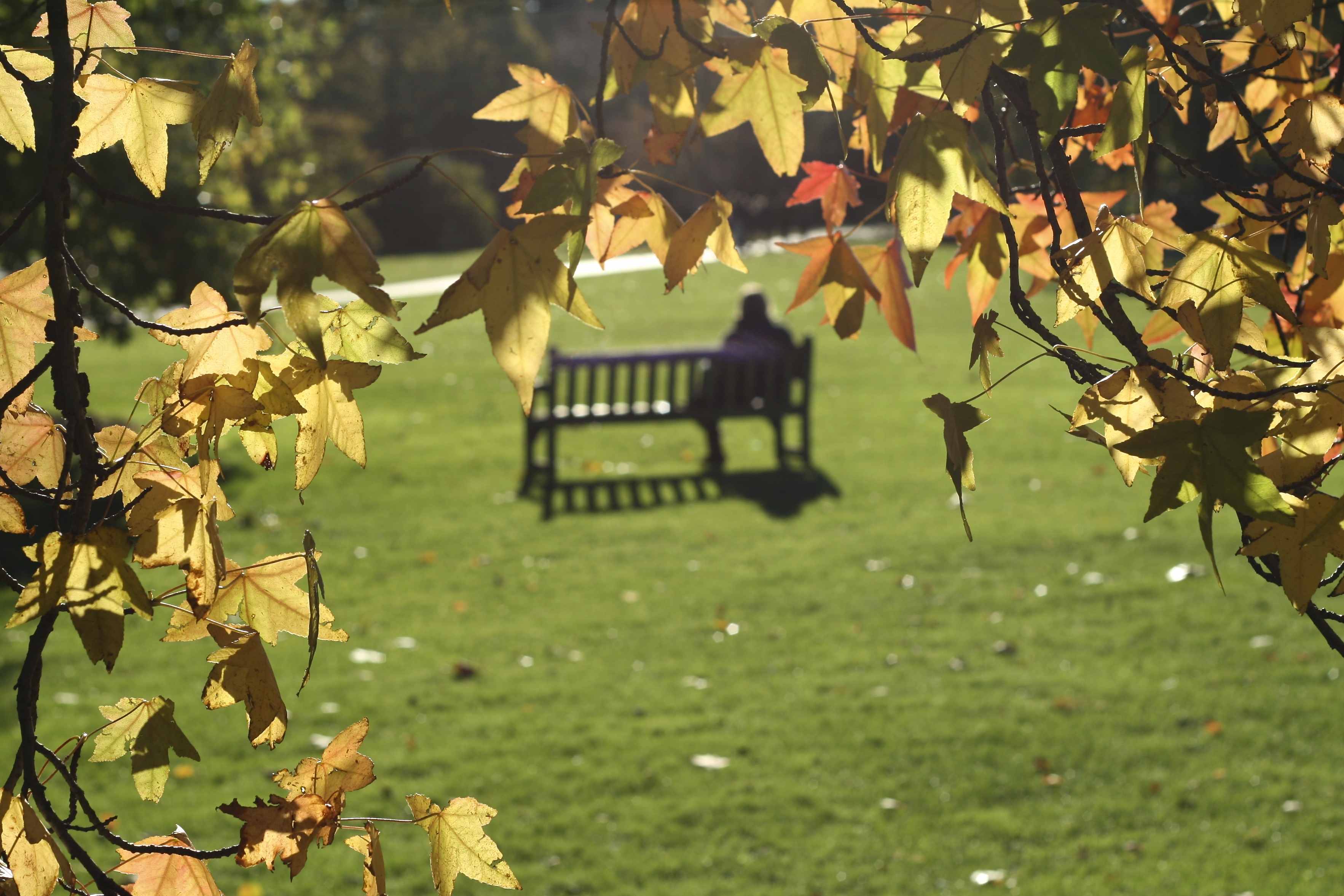
Parkinson's: Man on a park bench with autumn trees
A study suggests mindfulness could increase grey matter density in areas of the brain affected by Parkinson’s disease

Parkinson’s is the second most common neurodegenerative disease after Alzheimer’s. It affects 7 million people around the world, including one million people in the US and about 127,000 in the UK. The condition is caused by the death of nerve cells in the brain that produce the neurotransmitter dopamine, and its physical symptoms include tremor, rigidity and slowness of movement. There are also psychological effects, especially anxiety and depression.

You would expect mindfulness-based interventions to alleviate the psychological symptoms of Parkinson’s – mindfulness has proved its worth at reducing both anxiety and depression – but a recent study suggests mindfulness training could also address some of the physical changes in the brain. An eight-week course of mindfulness training seemed to increase the density of grey matter in two areas of the brain associated with the disease. Continue reading “Can mindfulness help preserve grey matter in Parkinson’s disease?”

Meditation changes the sleeping brain | Mindfulness research roundup

Man sleeping on a bench
Distinctive electrical activity has been found in the sleeping brains of experienced meditators

This month’s roundup of mindfulness research features studies of meditation’s effects on the sleeping brain; mindfulness for hypertension; and mindfulness-based cognitive therapy for depression in adolescents. Continue reading “Meditation changes the sleeping brain | Mindfulness research roundup”

Walking with the Buddha: a great photo opportunity?

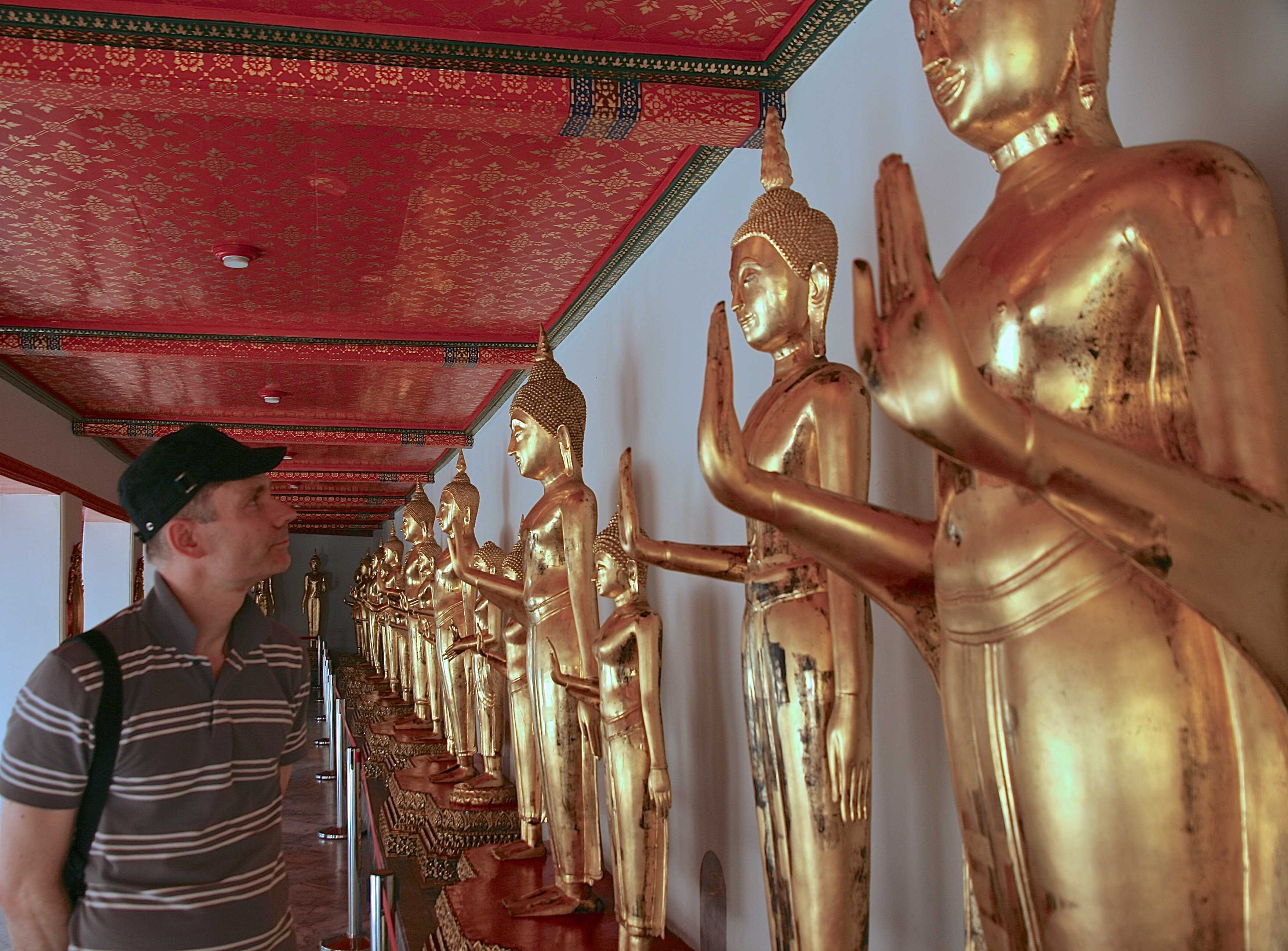
Buddha statues in the Grand Palace, Bangkok, Thailand
Being there is a concept, and the Buddha that you see is a mere appearance. You cannot photograph the real Buddha, even if you have a very expensive camera’

How we love our celebrities, even those of us who profess to be aloof from all that sort of thing. Special guests are often invited to morning conference at the newspaper where I work. These newsworthy people say whatever is on their mind and answer questions – all off-the-record. We’ve had some big names, heroes to many of us – Richard Dawkins, David Attenborough, Russell Brand, Jesse Jackson – and on these occasions the meeting room overflows with discretely adoring fans.

After Russell Brand’s appearance, in which he won us over with his wit and often obscene comic genius, many stayed behind to have their picture taken with him. Even feminist journalists, who might have baulked at his unashamed objectification of women, had fallen under his spell and elbowed their way through the crowd to get a priceless “selfie” on their smartphones with him. Continue reading “Walking with the Buddha: a great photo opportunity?”

Mindfulness monthly: irate taxi drivers, craving and paranoia

London taxi
A London taxi. Angry driving is bad driving. Photograph: Ed_g2s/Wikimedia Commons

Driving a stifling taxi cab on clogged city streets for hour after hour – scared half to death by careless pedestrians stepping into the road, harangued by passengers late for their lunch appointments, exasperated by the incompetence of your fellow drivers – would tax the patience of Mahatma Gandhi.

These men and women deserve our sympathy. They need our help to get through their shift without winding down the window and shouting obscenities at the next person who annoys them. Or worse. Quite apart from the danger to other road users, there is also ample evidence that anger can lead to a heart attack and raises the risk of heart disease.

Anger management

Psychologists have investigated the causes and consequences of aggressive, angry driving, but much less attention has been paid to strategies for preventing it. There have been a few attempts to measure how good cognitive behavioural therapy (CBT) and mindfulness-based cognitive therapy (MBCT) are at changing the attitudes and responses of angry drivers to certain cues, but now researchers in Iran have conducted the first study to compare the effectiveness of these two approaches. Continue reading “Mindfulness monthly: irate taxi drivers, craving and paranoia”

Uncanny synchronicity in the brain during near death experiences and meditation

Stone Buddha head enveloped by roots
The Buddha is said to have entered a state of deep meditation as he died

People who have had a near-death experience commonly report a sense of wellbeing and peace, detachment from the world, the feeling of being outside their own body, and seeing a bright light. People who meditate deeply often report very similar sensations. Research reported yesterday in the journal PNAS suggests what may link the two experiences. Continue reading “Uncanny synchronicity in the brain during near death experiences and meditation”